Flexible Distributed Particle Filtering for the Internet of Things via Aggregate Computing (2026)
Experimental artefact and simulation setup available at https://github.com/Field-Based-DPF/experiments-ac-based-distributed-particle-filtering.
This work was published in DCOSS-IoT 2026, pp. 601–606 (DOI: 10.48550/ARXIV.2606.18483).
This work is extended to multiple moving targets and mobile sensors in Multi-Target Tracking via Field-Based Distributed Particle Filtering.
Abstract
State estimation from uncertain observations collected across a network is central to many cyber-physical and Internet of Things (IoT) applications. Distributed Particle Filtering (DPF) supports nonlinear and non-Gaussian estimation, but existing solutions are often coupled to a particular network architecture or communication model. This makes them difficult to adapt to open and heterogeneous deployments.
This work proposes a field-based formulation of Distributed Particle Filtering grounded in Aggregate Computing. Estimation and information dissemination are expressed as computational fields, separating the core particle-filter logic from the mechanisms that coordinate devices and move data through the network.
This separation makes several design dimensions independently configurable:
- the placement and resilience of fusion centres, realised as dynamically elected leaders that are replaced upon failure;
- the aggregated measurement functions, combining raw local observations of neighbouring devices into a richer, distributed "virtual sensor";
- the type of information exchanged among nodes (particles, beliefs, likelihoods, or raw measurements);
- the spatial and topological scope of dissemination, e.g., restricting the filtering to the sensors close to the estimated target.
Experiment description
The evaluation considers a target-tracking scenario in a two-dimensional environment. A network of 25 static sensors is deployed on a grid (with small random perturbations), while a single object moves along a non-linear sinusoidal trajectory at constant speed. Sensors perceive the radio signal emitted by the target through a log-distance path-loss model with Gaussian noise: the farther the target, the weaker and noisier the measurement.
Sensors run their computation at 1 Hz without synchronisation; each run lasts 3,000 simulated seconds and is repeated with 100 random seeds. Two experiments are derived from the same field-based specification:
- Aggregated measurement function: every sensor runs its own local particle filter, and enriches its weighting step with the measurements shared by its neighbours (no particles are exchanged). The neighbourhood size varies over 0, 1, 4, and 7.
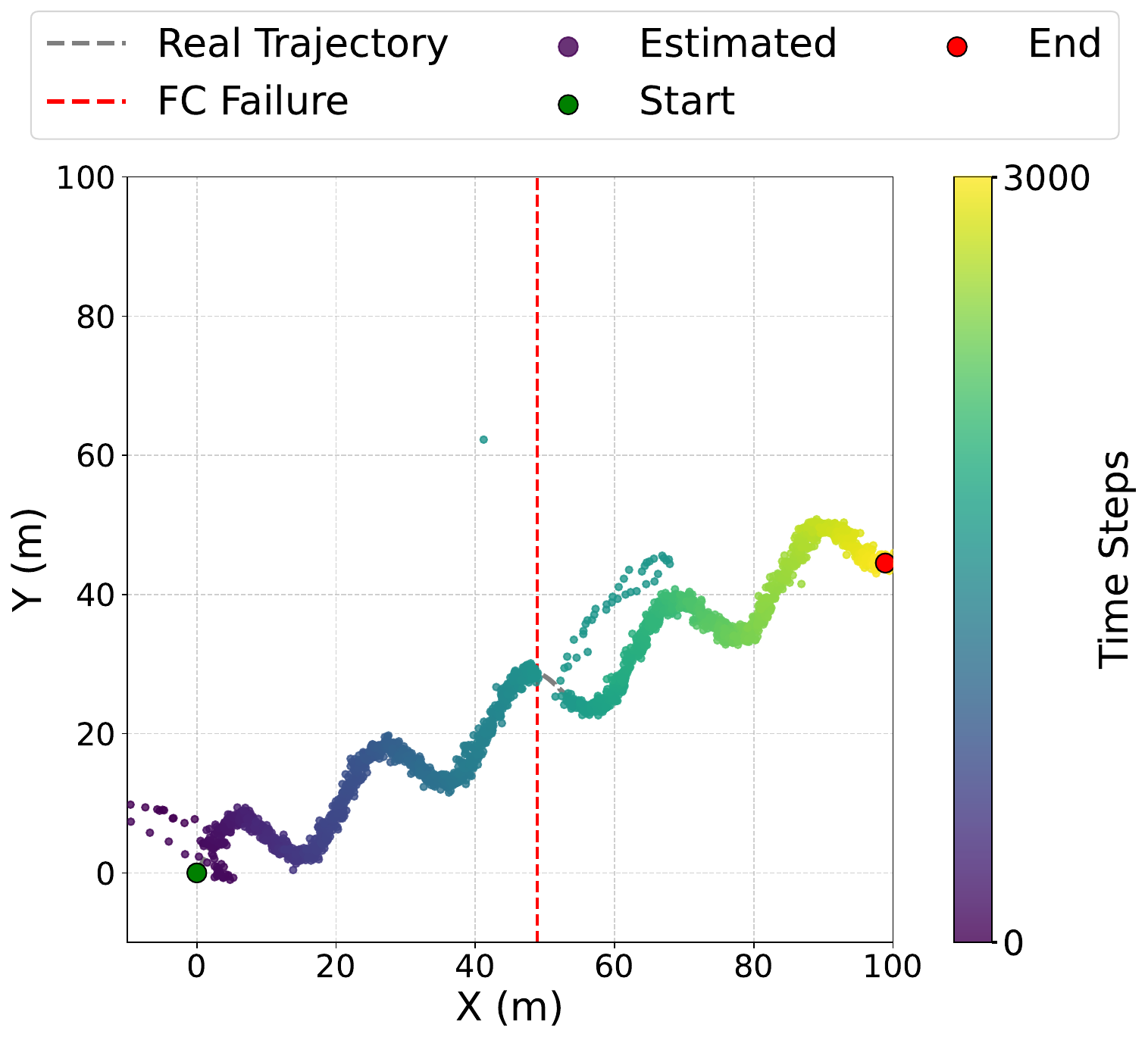
- Fusion centre as an elected leader: measurements are collected through a converge-cast towards a dynamically elected leader, which runs the particle filter. At time step 1,500 the leader fails, and a new one is elected by the aggregate program.
Results
Aggregated measurements
With no neighbours, the filters fail to converge due to the limited amount of information. As the neighbourhood grows, the aggregated measurement becomes more informative: a single neighbour already improves the estimate significantly, and with the estimate is both accurate and stable.
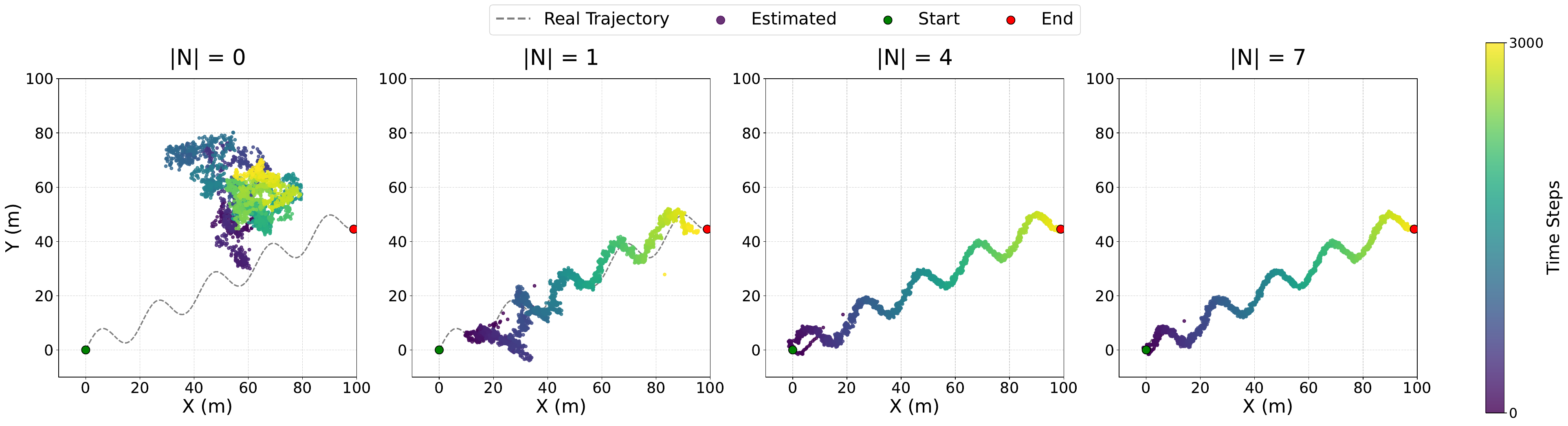
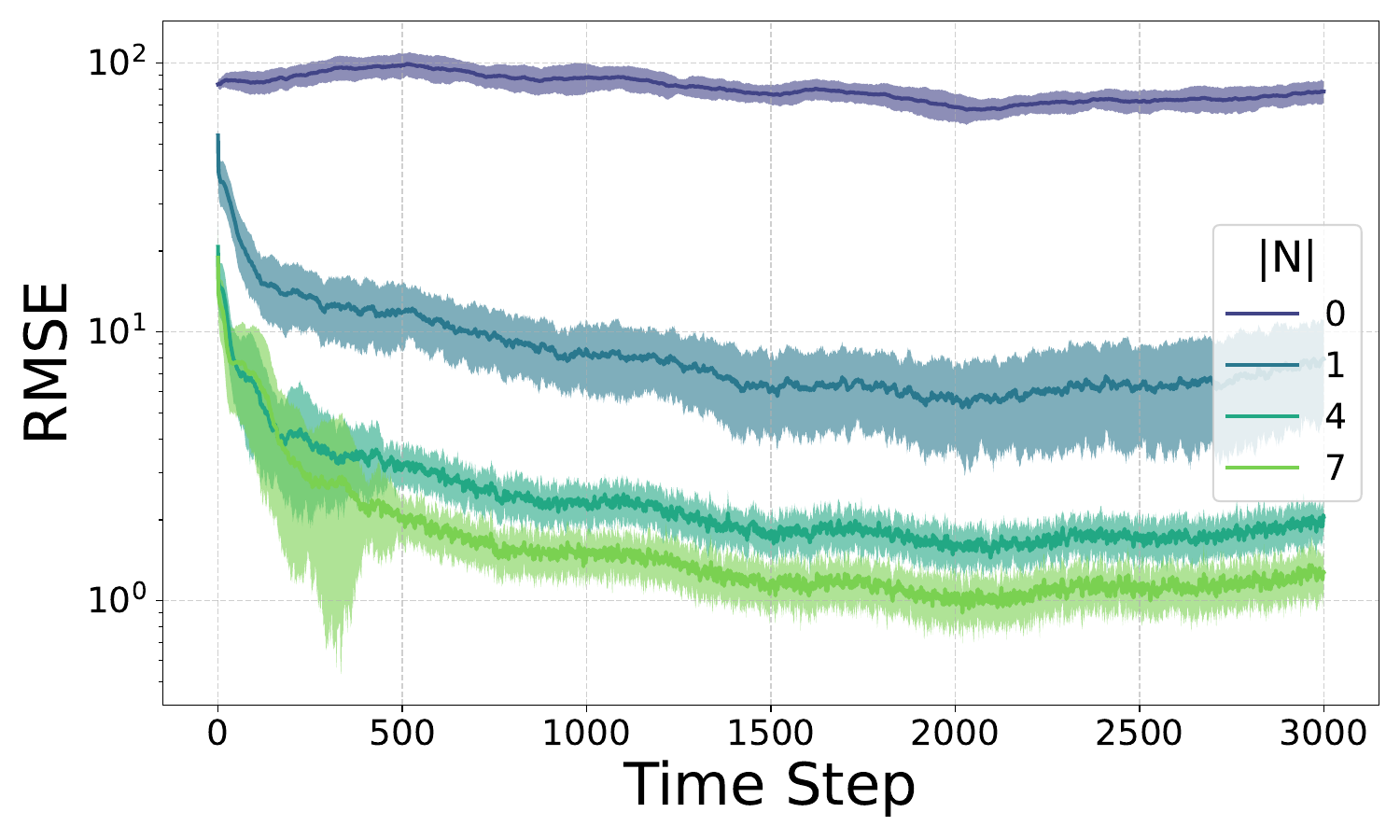
Average RMSE over 100 random seeds; shaded areas indicate variance.
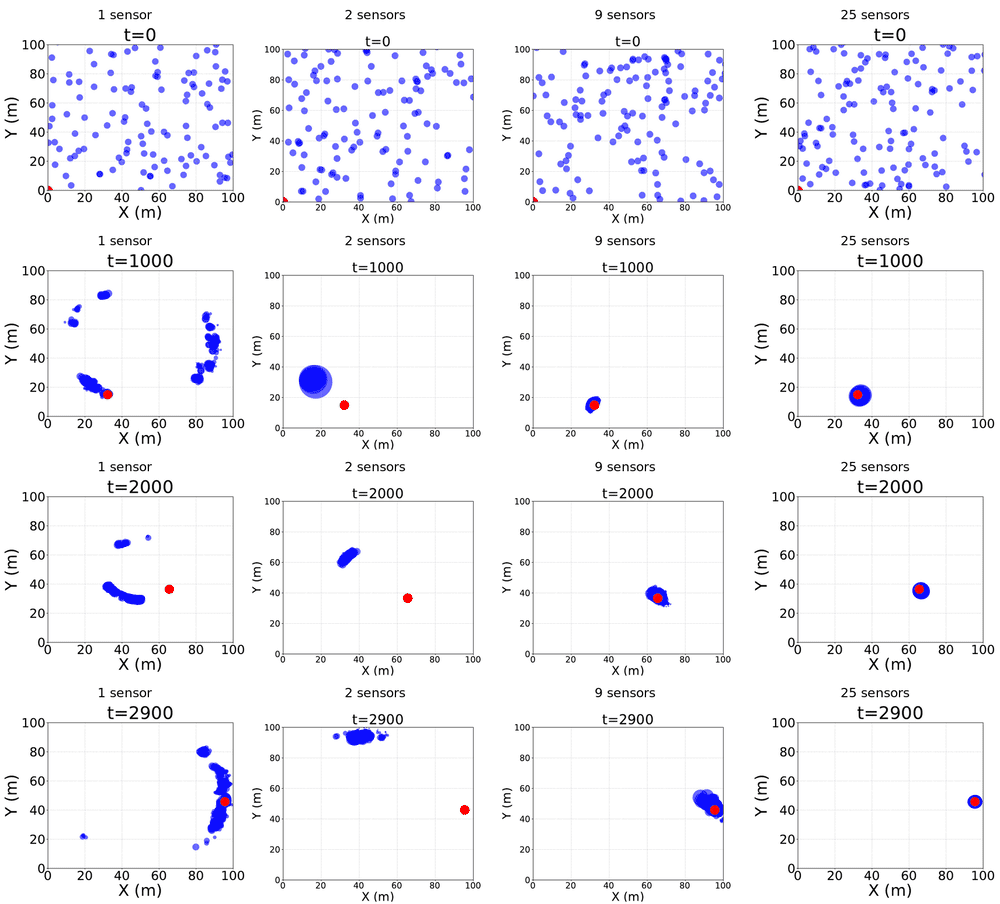
The animation below shows how the particles of a local filter evolve over time when the measurement function aggregates the observations of an increasing number of sensors. The red dot is the real position of the target, blue dots are the particles: the more sensors contribute, the faster and tighter the particles concentrate around the target.
Leader-based fusion centre
The fusion centre exhibits two short transients: one at the beginning, when the first leader is elected, and one after the failure at time step 1,500. Once the new leader is elected, it takes over the fusion role and keeps tracking the target, showing that the field-based fusion centre self-heals without external intervention.
Overall, the evaluation positions Aggregate Computing as an abstraction layer for adaptable distributed estimation: the particle-filter implementation remains reusable, while coordination policies can be changed to match the topology, sensing model, and resilience requirements of an IoT deployment.