Toward Safe Aggregate Computing: A Distributed Control-Theoretic Safety Filter for Robot Swarms (2026)
Experimental artefact and simulation setup available at https://github.com/angelacorte/experiments-2026-acsos-ws-carol.
This work was presented at the 2026 IEEE International Conference on Autonomic Computing and Self-Organizing Systems Companion (ACSOS-C 2026). The DOI is not yet available.
Abstract
Robot swarms need to coordinate their motion while satisfying safety requirements such as obstacle avoidance, inter-robot separation, and bounded speed. Aggregate Computing makes it easy to specify adaptive swarm-level behaviour, but its self-stabilisation guarantees are eventual: during transients, or while the environment keeps changing, the commands computed by the aggregate program may be unsafe.
This work presents CAROL (Coordinated Aggregate Robotics with Online control Lyapunov and barrier functions), an architecture that integrates Aggregate Computing with a control-theoretic safety filter. The aggregate program computes the nominal collective behaviour, while a safety-filtering layer refines the resulting commands through Control Lyapunov Functions (CLFs), which drive robots towards their goals, and Control Barrier Functions (CBFs), which constrain their motion to preserve safety. Constraints are enforced on each robot in a fully distributed fashion.
Architecture
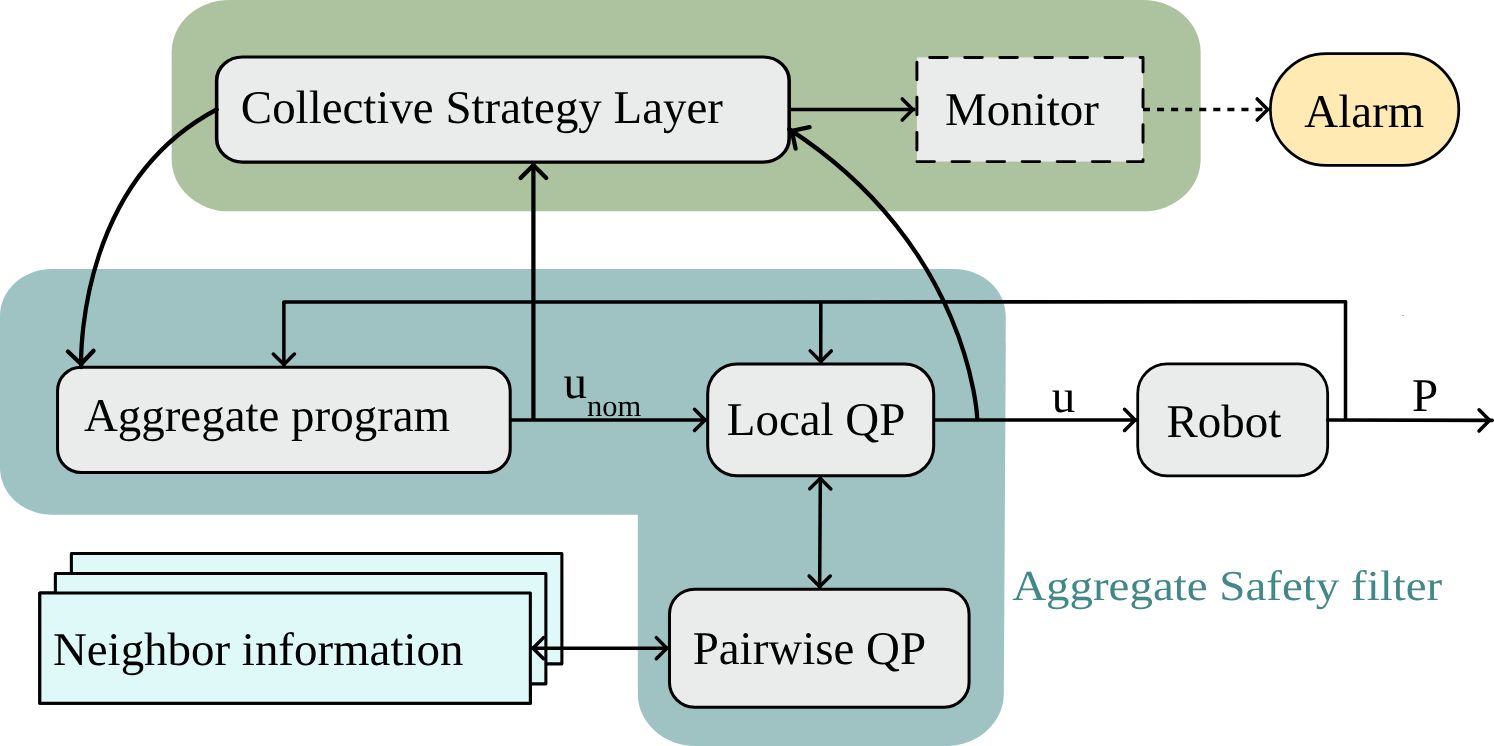
Each robot runs the same aggregate program, which computes a nominal input from its local state and neighbour information. Before being applied, is refined by the safety filter into a safe input , which stays as close as possible to the nominal one while satisfying the active constraints. Both commands are fed back to a collective strategy layer, which can reason about the next actions (e.g., re-planning when convergence is too slow).
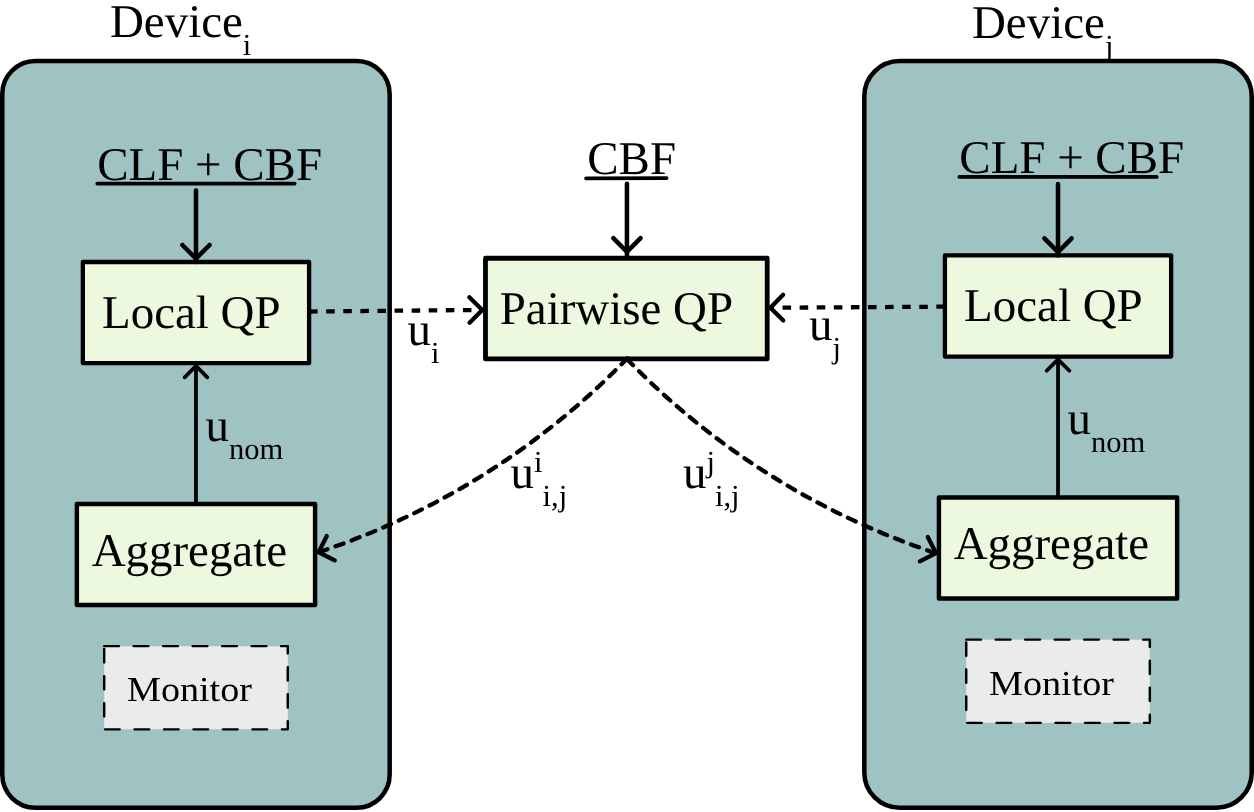
Constraints involving a single robot (target convergence, speed limit, obstacle avoidance) are handled by a local QP, whereas constraints coupling two robots (collision avoidance, communication-range preservation) are handled by a pairwise QP using information exchanged with neighbours. The coupled problem is solved through the Alternating Direction Method of Multipliers (ADMM): robots iteratively exchange their pairwise solutions with neighbours until convergence, without any central coordinator.
Experiment description
The proof-of-concept experiments run in Alchemist, with the QPs solved by Gurobi. Each experiment considers 4 robots, modelled as points moving in a 2D plane with single-integrator dynamics (). Robots communicate within a 10 m range, must keep a minimum distance of 2 m from each other, cannot exceed a speed of 2 m/s, and must stay out of the obstacles' unsafe region (2 m radius plus a 1.5 m safety margin).
At every round, the safety filter solves:
subject to a soft CLF constraint for target convergence (relaxed through the slack ), and hard CBF constraints for obstacle avoidance, inter-robot collision avoidance, communication-range preservation, and maximum speed.
Results
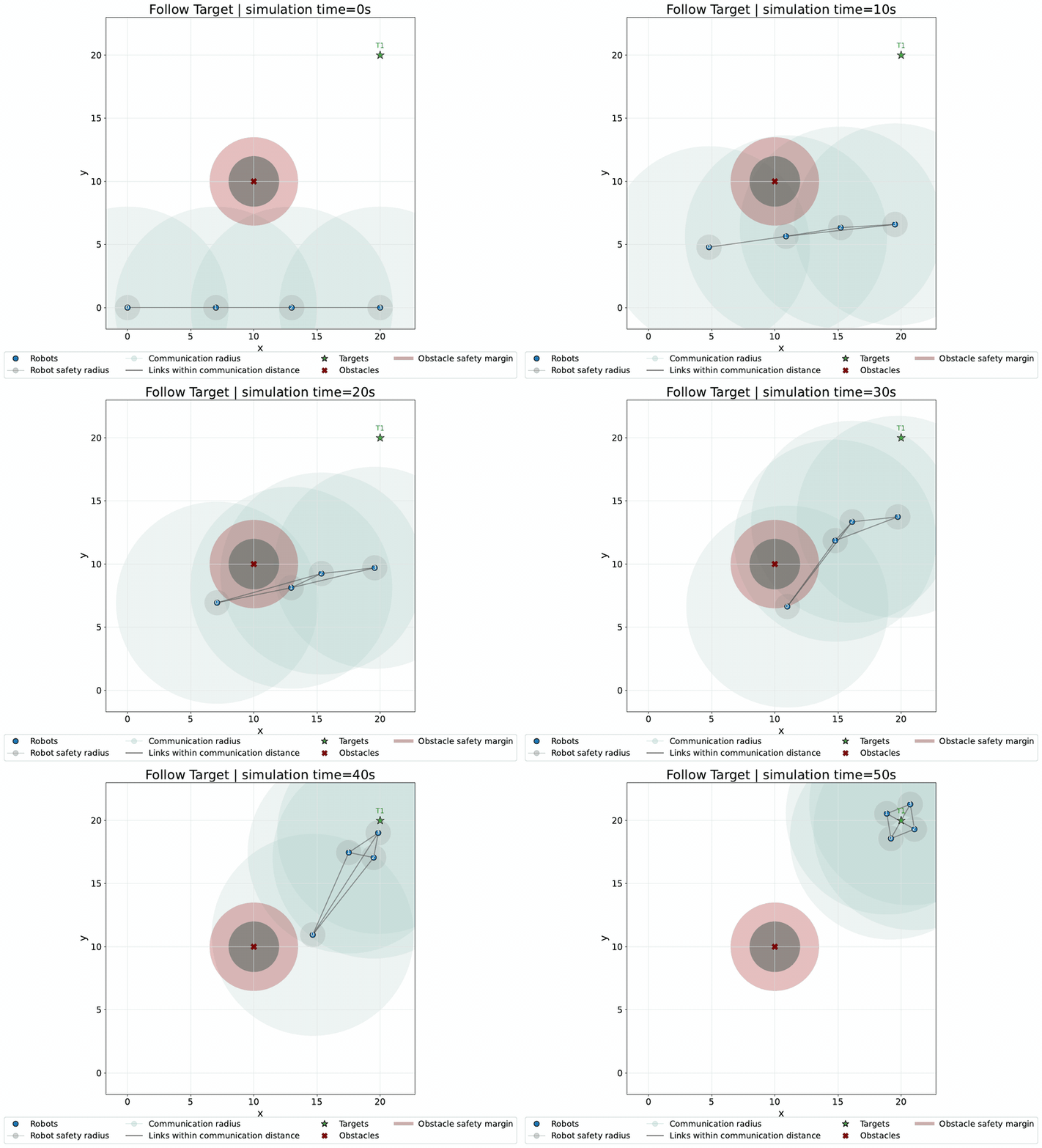
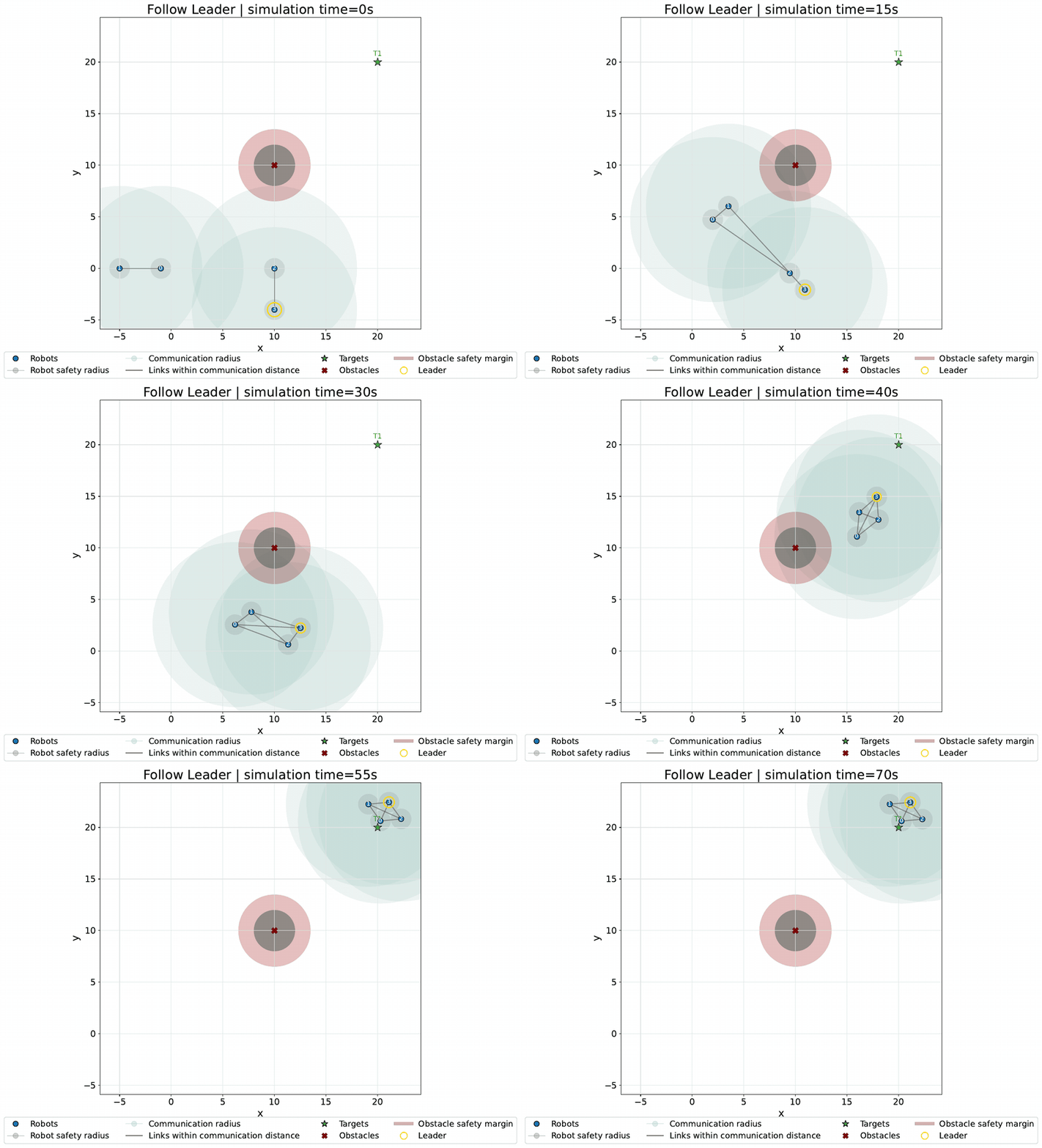
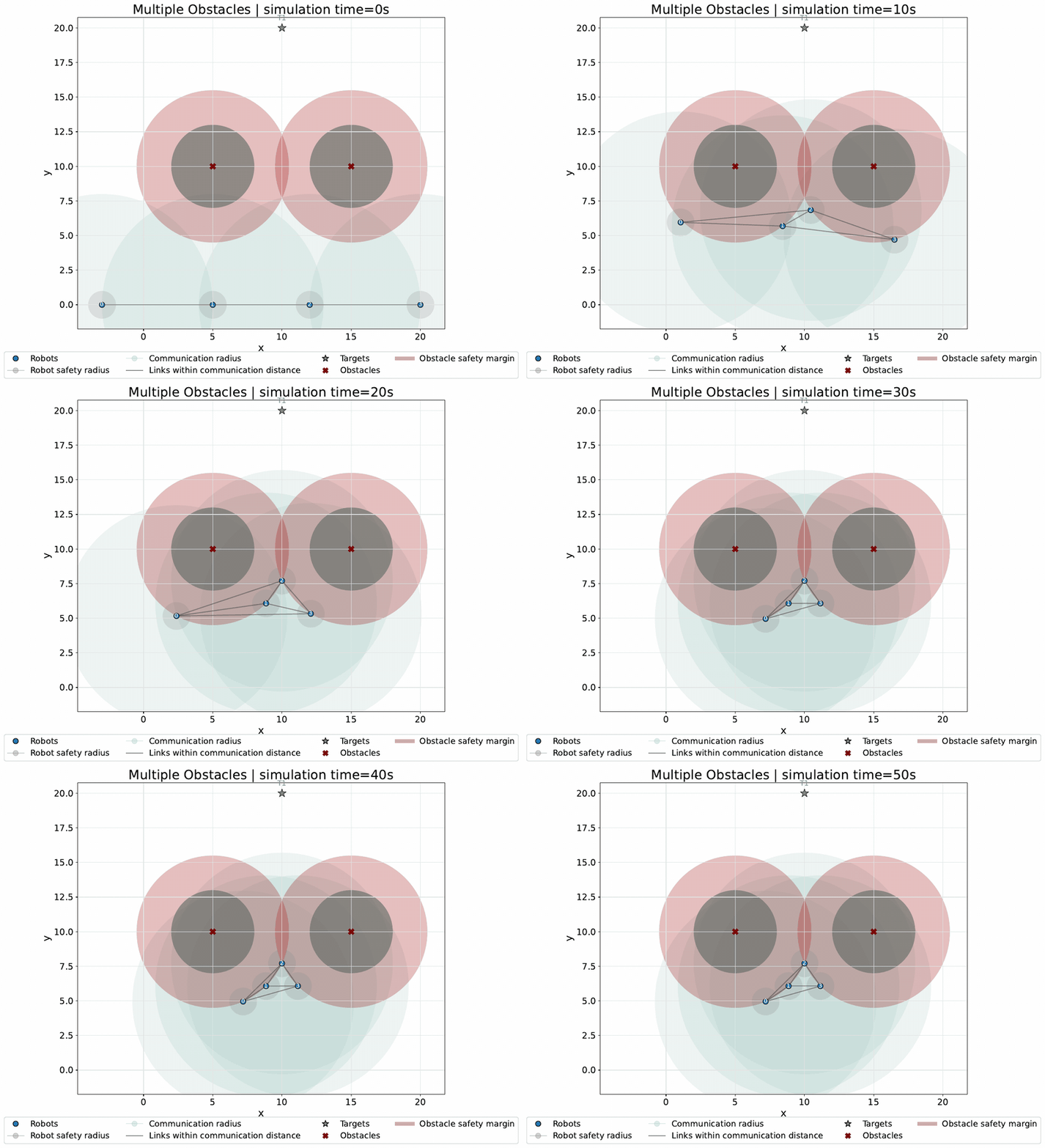
In all the animations, robots are blue dots surrounded by their safety radius, the light circles are their communication ranges, and grey lines are links between robots within communication distance. Targets are green stars, and obstacles are dark red crosses surrounded by their unsafe region and safety margin.
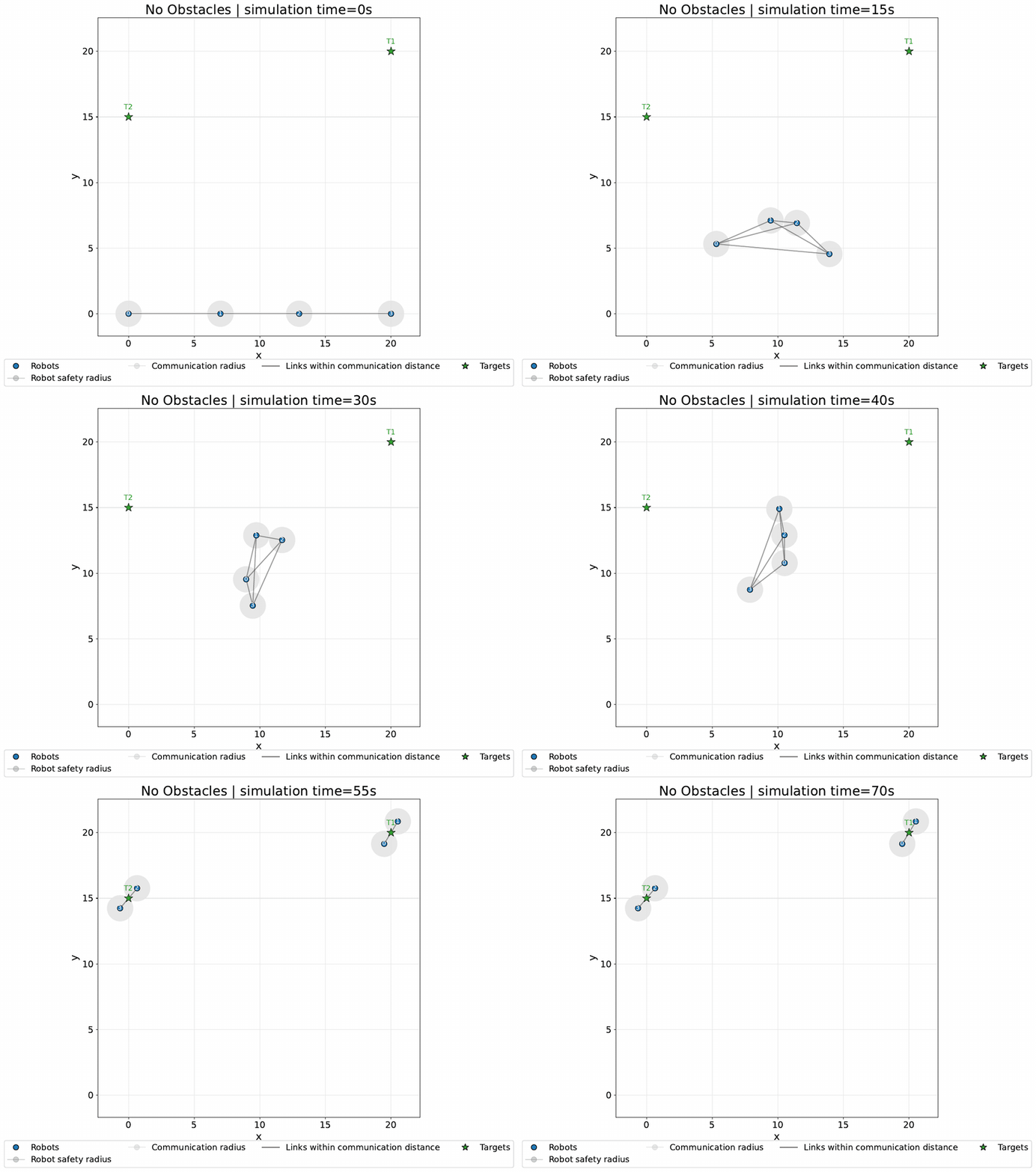
No obstacles
Two groups move towards different goals in free space, respecting speed and collision constraints.
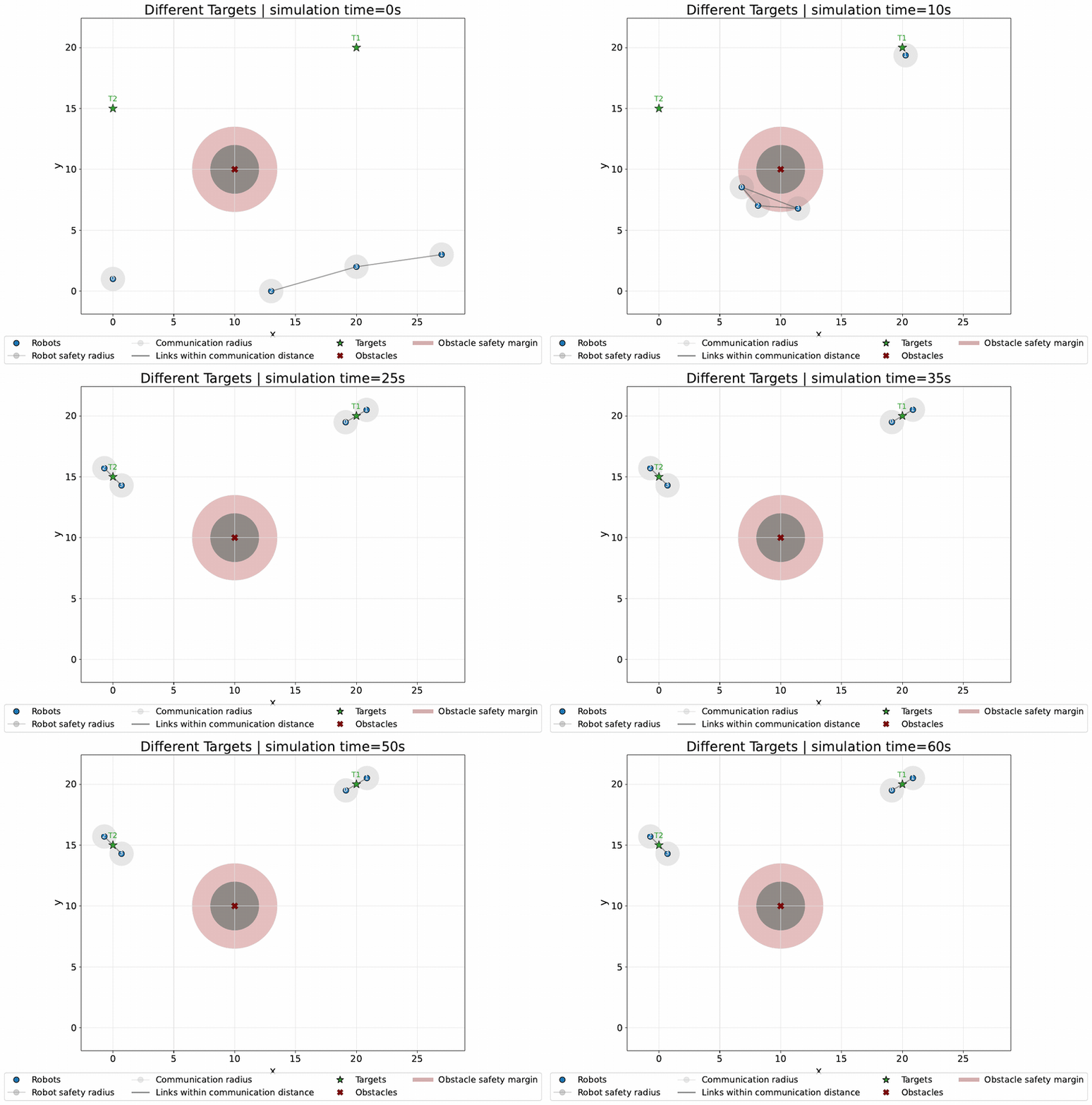
Different targets with collision and obstacle avoidance
Robots 0 and 1 are assigned to target , while robots 2 and 3 are assigned to target . Both groups reach their targets without colliding with each other or with the obstacle.
Common target
The swarm moves towards a shared target, going around a static obstacle while preserving connectivity when possible.
Leader election and connectivity preservation
Within each communication neighbourhood, the robot with the highest identifier is elected leader (yellow circle) and moves towards the target, while the others follow it. Initially two disconnected clusters follow different leaders; once they enter communication range they merge, elect a common leader, and follow it while preserving connectivity, avoiding collisions, and navigating around the obstacle.
Multiple obstacles: local minima
The relative position of targets and obstacles may trap the robots in a local minimum of the target-convergence CLF: active obstacle-avoidance constraints block direct convergence, even though a feasible path exists. Safety is never violated, but this scenario motivates the collective strategy layer, which could switch to an alternative navigation strategy (e.g., exploration or waypoint selection) at runtime.
Together, these experiments show how Aggregate Computing can act as the coordination layer for control-theoretic safety mechanisms, keeping the specification of the collective behaviour separate from the enforcement of physical constraints.