Multi-Target Tracking via Field-Based Distributed Particle Filtering (2026)
Experimental artefact and simulation setup available at
https://github.com/Field-Based-DPF/experiments-acsos-2026-DPF-multi-object-tracking

This work was presented at the 2026 IEEE International Conference on Autonomic Computing and Self-Organizing Systems (ACSOS 2026). The paper DOI is not yet available.
The artifact associated with this article has won the Best Companion Artifact Award at ACSOS 2026.
Abstract
Tracking several moving targets from observations collected by a distributed sensor network requires nodes to combine uncertain, partial information without relying on permanent centralized infrastructure. Particle filters are well suited to nonlinear and non-Gaussian estimation, but existing Distributed Particle Filtering (DPF) approaches are often tied to fixed architectures, predefined roles, or rigid communication assumptions.
Building on the field-based formulation of DPF introduced in Flexible Distributed Particle Filtering for the Internet of Things via Aggregate Computing, this work uses Collektive to turn DPF into a self-organising collective process: sensing, information dissemination, role assignment, and particle-based estimation are all expressed as computational fields. As a result, the architecture becomes a runtime coordination choice rather than a fixed property of the filtering algorithm, supporting:
- self-organisation, through neighbourhood-level aggregation of local measurements;
- self-healing, through fusion centres realised as dynamically elected leaders, replaced upon failure;
- self-adaptation, through mobile sensors that reorganise their spatial configuration around the moving targets.
Experiment description
Target trajectories are derived from the KABR telemetry dataset of drone-based wildlife observations: three zebra tracks are converted into planar coordinates and used as moving targets. Each target emits a radio-like signal carrying a unique identifier, and sensors perceive it through a noisy log-distance path-loss model. Each sensor runs a single multi-target particle filter, maintaining particles and estimates per target identifier.
All experiments use 24 sensors placed on a grid with small random perturbations, execute rounds at 1 Hz without global synchronisation, last 1,400 simulated seconds, and are repeated with 50 random seeds. Three scenarios exercise different coordination patterns over the same field-based filter:
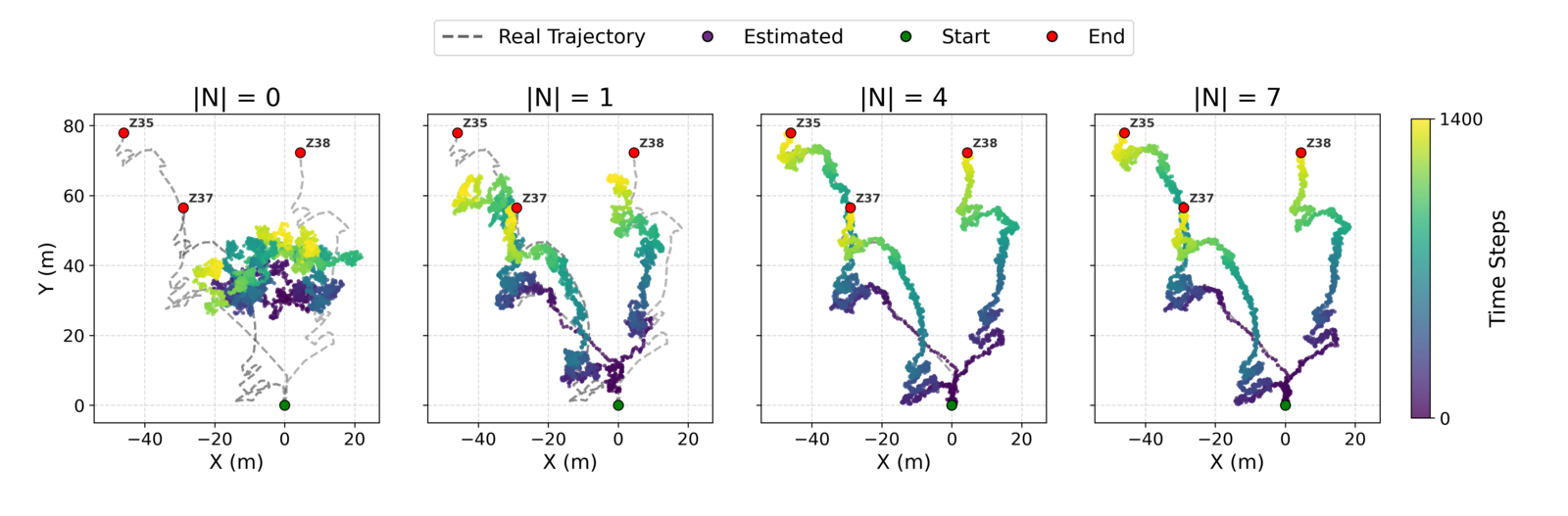
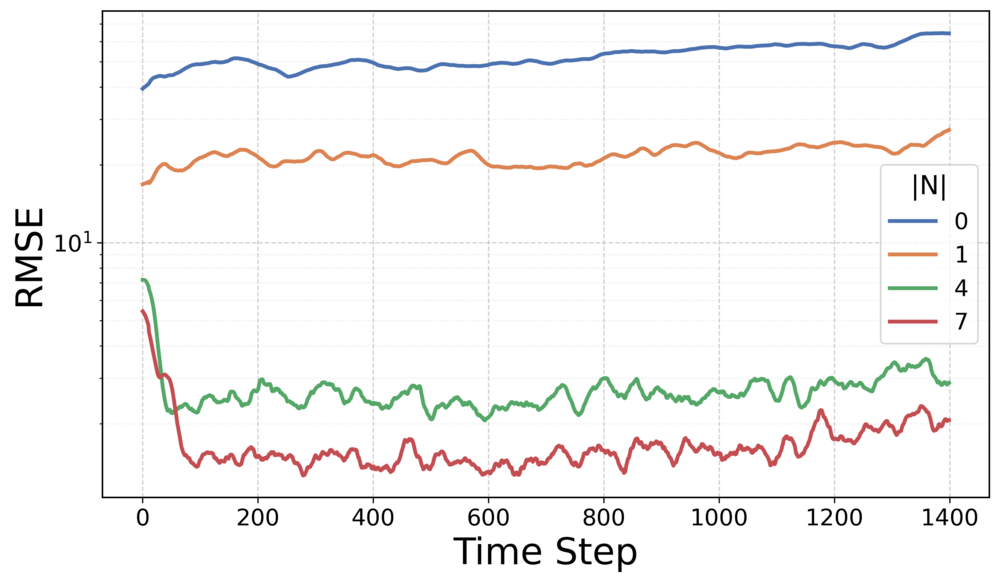
- Fixed sensors, neighbourhood-level aggregation: each sensor refines its local filter with the observations of its neighbours (no particles are exchanged), with neighbourhood size in 0, 1, 4, and 7.
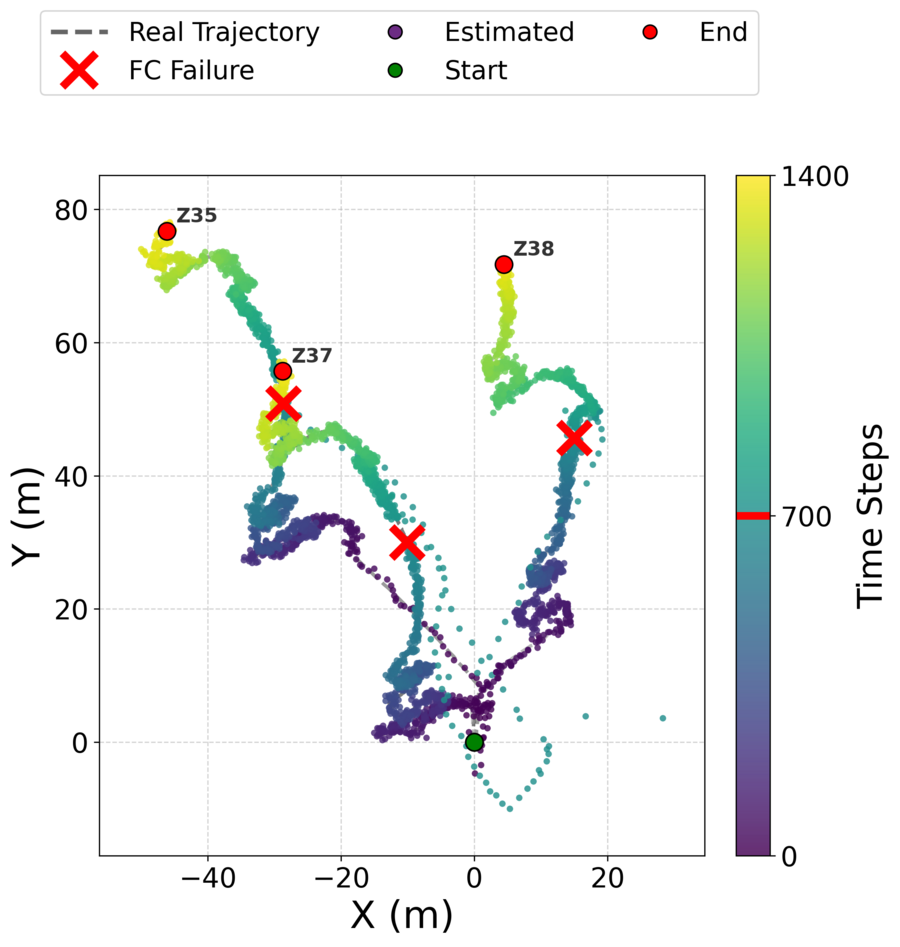
- Fixed sensors, leader-based fusion centre: measurements are routed through a converge-cast towards a leader elected via a geometric centrality score. The leader is failed halfway through the simulation (time step 700) to evaluate recovery through a new election.
- Mobile sensors, neighbourhood-level aggregation: the sensors keep a grid-like formation whose centroid follows the estimated centroid of the zebras. A temporary coordinator is elected only for motion coordination, while particle filtering remains fully decentralised.
Results
Neighbourhood-level aggregation
With , each sensor relies only on its own noisy measurements, which are insufficient to reconstruct the trajectories. Sharing observations among neighbours progressively improves the estimates, and larger neighbourhoods yield accurate and stable tracking of all three targets without any fusion centre.
Leader-based fusion centre with failure
When the elected leader fails at time step 700, the estimates temporarily degrade. After the new leader is elected, the system self-heals and the trajectories progressively stabilise.
Mobile sensors
The mobile sensors (blue) preserve a grid-like formation centred around the barycentre of the three zebras (pink), coupling distributed estimation with self-organising mobility.
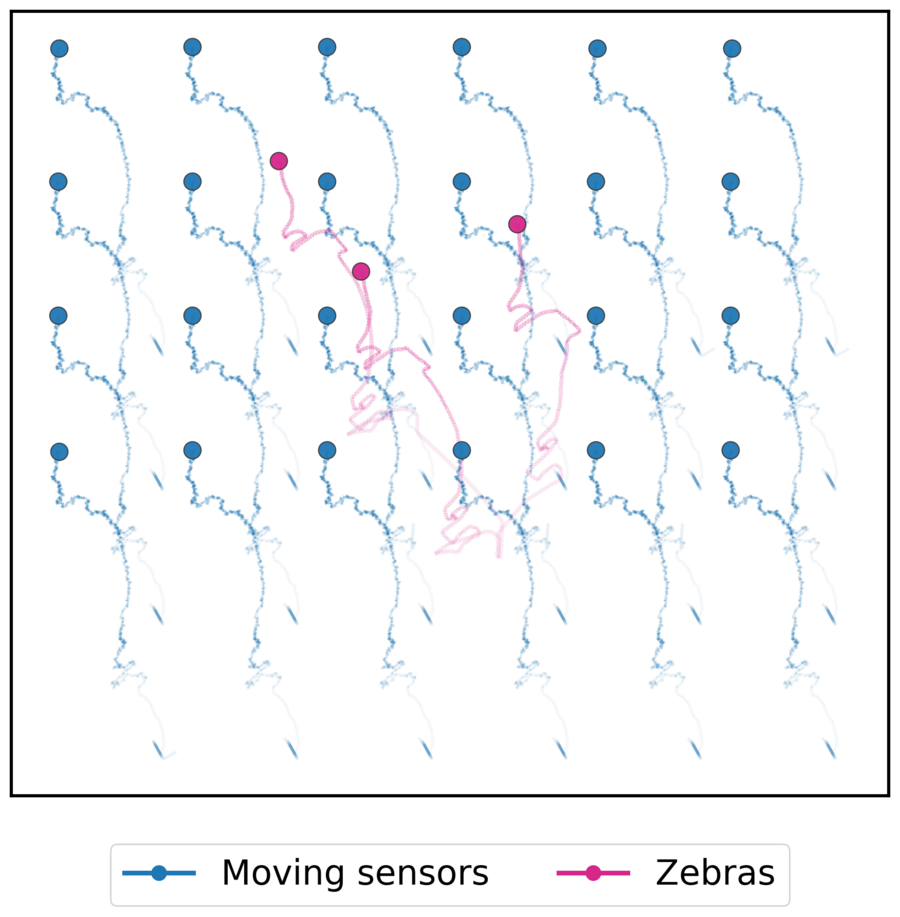
The quality of motion coordination directly affects estimation accuracy: the farther the formation drifts from the tracked targets, the less informative the measurements, and the higher the RMSE.
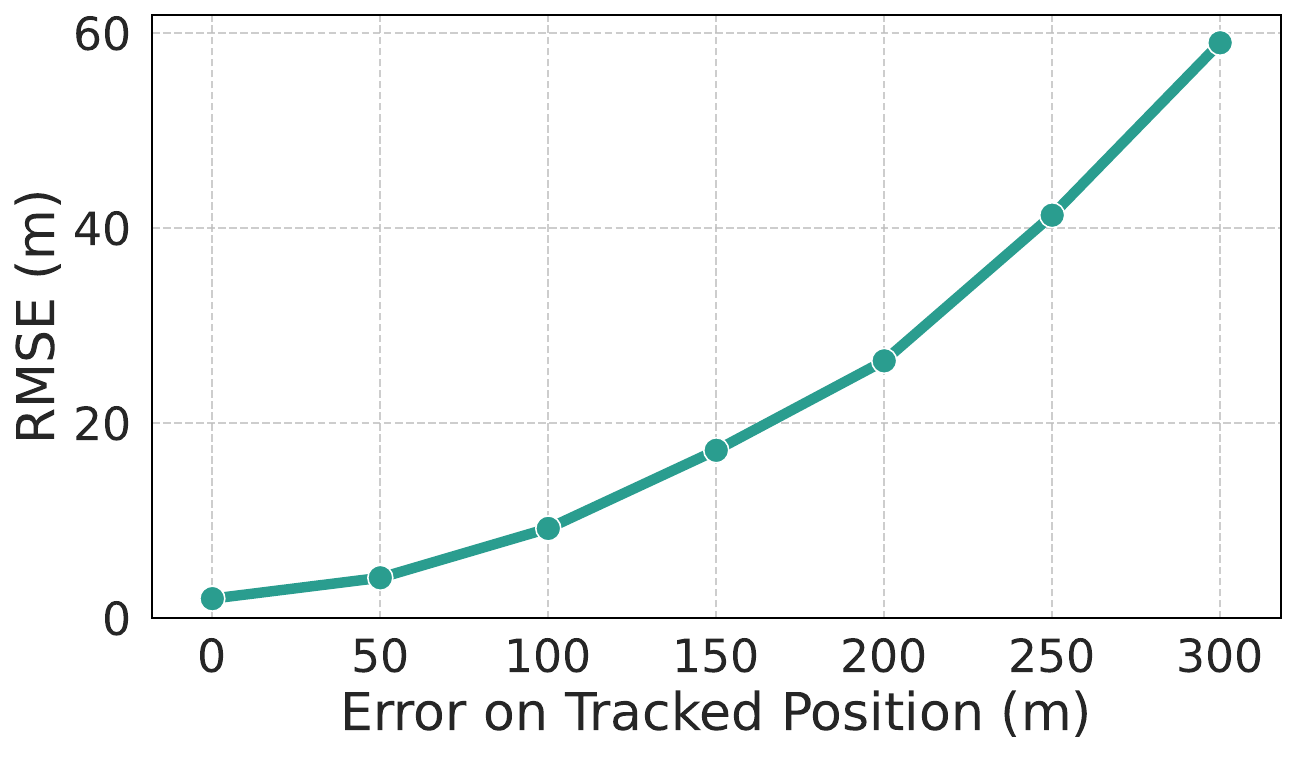
Overall, the artefact shows that tracking logic, information propagation, leader election, and collective sensor motion can be expressed as composable aggregate mechanisms while retaining the same underlying particle-filter model.