A Self-stabilizing Min-Max Consensus via Path-Loop Detection (2026)
Experimental artefact and simulation setup available at
https://github.com/angelacorte/experiments-coordination-self-stabilizing-gossip

This work was published in COORDINATION 2026, pp. 93–114 (DOI: 10.1007/978-3-032-28358-0_5).
The artefact associated with this article has been awarded the EAPLS Artifacts Available and Artifacts Evaluated – Functional badges.
Abstract
Min-max consensus allows the nodes of a distributed system to converge on the best value produced by any participant. Traditional gossip implementations are monotonic: once a value has been incorporated into the aggregate, it cannot be retracted. Consequently, values made obsolete by a transient fault, a changed local input, or a network partition can continue to circulate indefinitely.
This work introduces a self-stabilizing min-max consensus algorithm based on path-loop detection. Each gossip message carries both a candidate value and the path of nodes that acknowledged it. Nodes propagate information along shortest valid paths, use the path to prevent loops, and naturally prune contributions that are no longer supported by the current network state.
The algorithm is presented through Aggregate Computing, formally shown to self-stabilize (it is an instance of the minimizing-share pattern), and implemented as a reusable operation for the Collektive DSL. It provides a resilient coordination building block for large-scale and pervasive distributed systems.
The algorithm
Every device propagates a pair , where is the best value known so far and is the path of devices leading to the closest device holding it. At each round, a device:
- discards every neighbor candidate whose path already contains itself (loop detection);
- selects the best value according to the comparator;
- breaks ties by preferring the shortest path, and then the lowest identifier;
- appends its own identifier to the selected path and forwards it.
When the device holding the best value disappears, the stale candidates that still refer to it eventually loop back and get pruned, and the next best value spreads along the shortest valid paths:
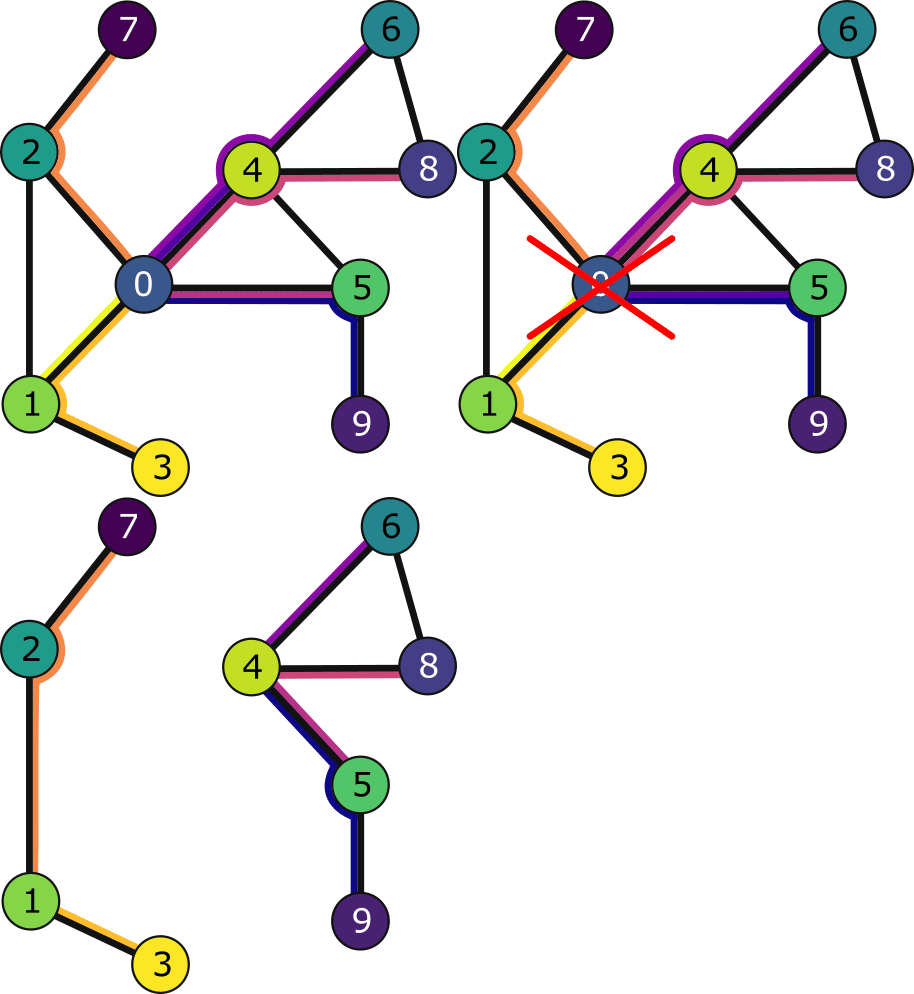
Nodes are labelled with their identifiers (the algorithm searches for the minimum), black lines are communication links, and colored arcs show the shortest valid path through which each node received its value. When node 0 fails, the network splits and each partition converges to its own best value.
The core of the implementation in Collektive is a single share with a fold over the neighbors' candidates:
data class GossipValue<ID : Comparable<ID>, Value>(
    val best: Value,
    val path: List<ID> = emptyList(),
) {
    fun addHop(id: ID) = GossipValue(best, path + id)
}

fun <ID : Comparable<ID>, Value> Aggregate<ID>.findMaxOf(local: Value, comparator: Comparator<in Value>): Value {
    val localGossip = GossipValue<ID, Value>(best = local)
    return share(localGossip) { gossip ->
        gossip.neighbors.values.fold(localGossip) { current, neighbor ->
            when {
                localId in neighbor.path -> current // ignore paths that loop back
                else -> when (comparator.compare(neighbor.best, current.best)) {
                    0 -> when { // same value: prefer the shortest path, then the lowest sender
                        neighbor.path.size == current.path.size -> listOf(neighbor, current).minBy { it.path.last() }
                        else -> listOf(neighbor, current).minBy { it.path.size }
                    }
                    in 1..Int.MAX_VALUE -> neighbor
                    else -> current
                }
            }
        }.addHop(localId)
    }.best
}
A generalised version of this path-based, loop-free gossip is available in the Collektive standard library
(it.unibo.collektive.stdlib.spreading), through gossipMax, gossipMin, and their ...By/...With variants
accepting a selector or a comparator:
val minimumId = gossipMin(localId)
val hottest = gossipMaxBy(sensorReading) { it.temperature }
Experiment description
The evaluation uses Alchemist to simulate devices randomly deployed in a two-dimensional square arena. Communication is proximity-based: each device exchanges information only with neighbors within a fixed range, and every node executes rounds at 1 Hz, starting asynchronously. Every numeric experiment is repeated 32 times with different random seeds.
The main split-and-merge scenario uses devices in a m arena with a 4 m communication range, and lasts 200 simulated seconds:
- Nodes start with random values in and run min-consensus for 50 seconds.
- The network is partitioned by moving the devices on the right side of the arena into a separate area.
- After another 50 seconds, every node receives a new random value in .
- The two groups are reconnected and allowed to converge again for a final 50 seconds.
The evaluation compares three approaches under these perturbations:
- Non-stabilizing gossip: the conventional monotonic min-max consensus baseline.
- Self-stabilizing gossip: the proposed path-based algorithm.
- Time-replicated gossip: non-stabilizing gossip wrapped in time replication to obtain self-stabilization ( replicas, launch period s).
Correctness is measured as the Root Mean Squared Error (RMSE) with respect to an oracle, computed separately for each partition; communication cost is measured as the data rate needed to sustain the algorithm.
Results
The algorithm at work
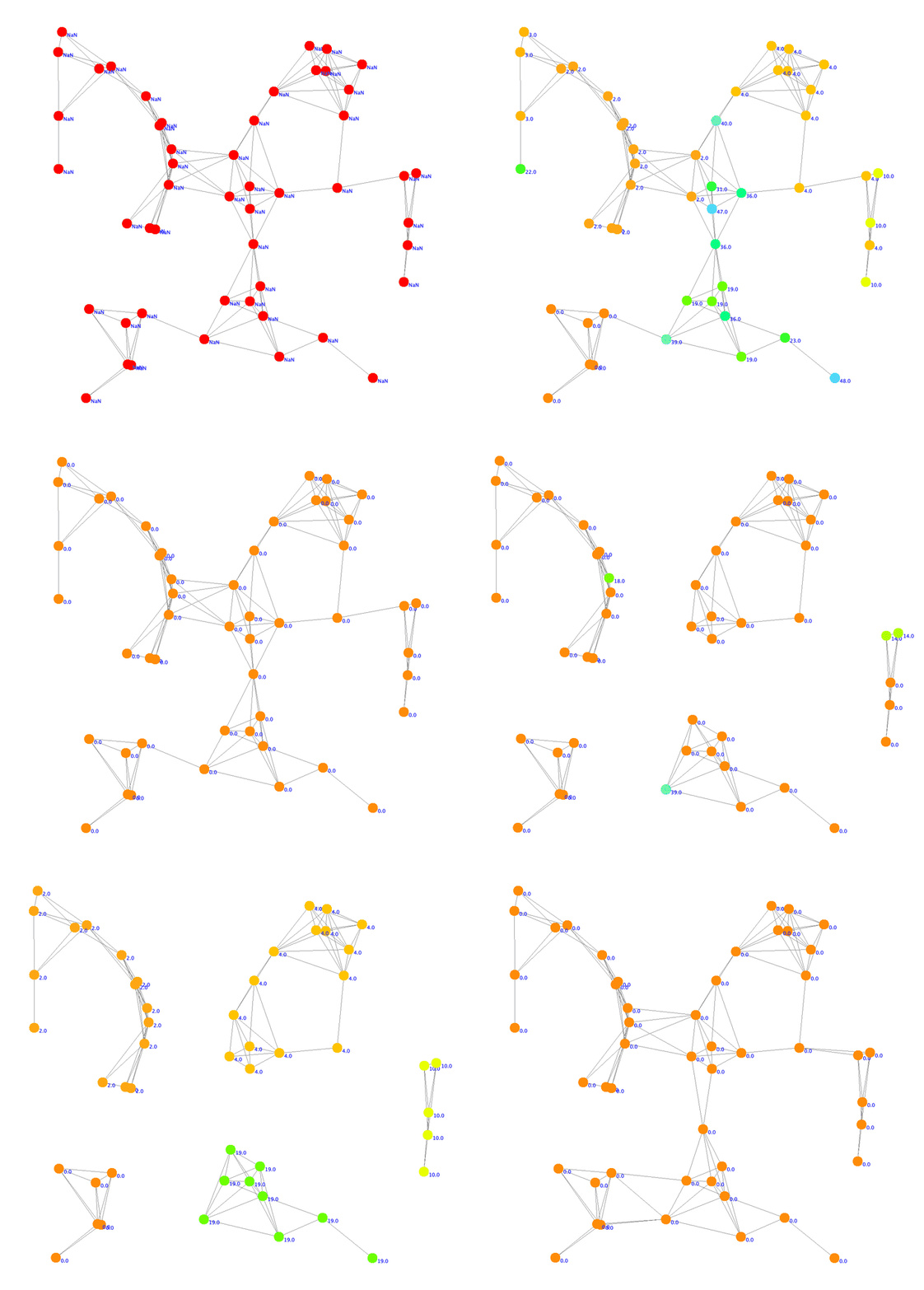
The animation below shows the algorithm in a scenario with 50 devices ( m, m) configured to find the minimum identifier in the network (0). Node color represents the currently selected value, so equal colors indicate agreement. The stabilized network is partitioned in five segments, each segment converges to the best value it contains, and once the network is reconnected the whole system returns to the initial best value.
Performance analysis
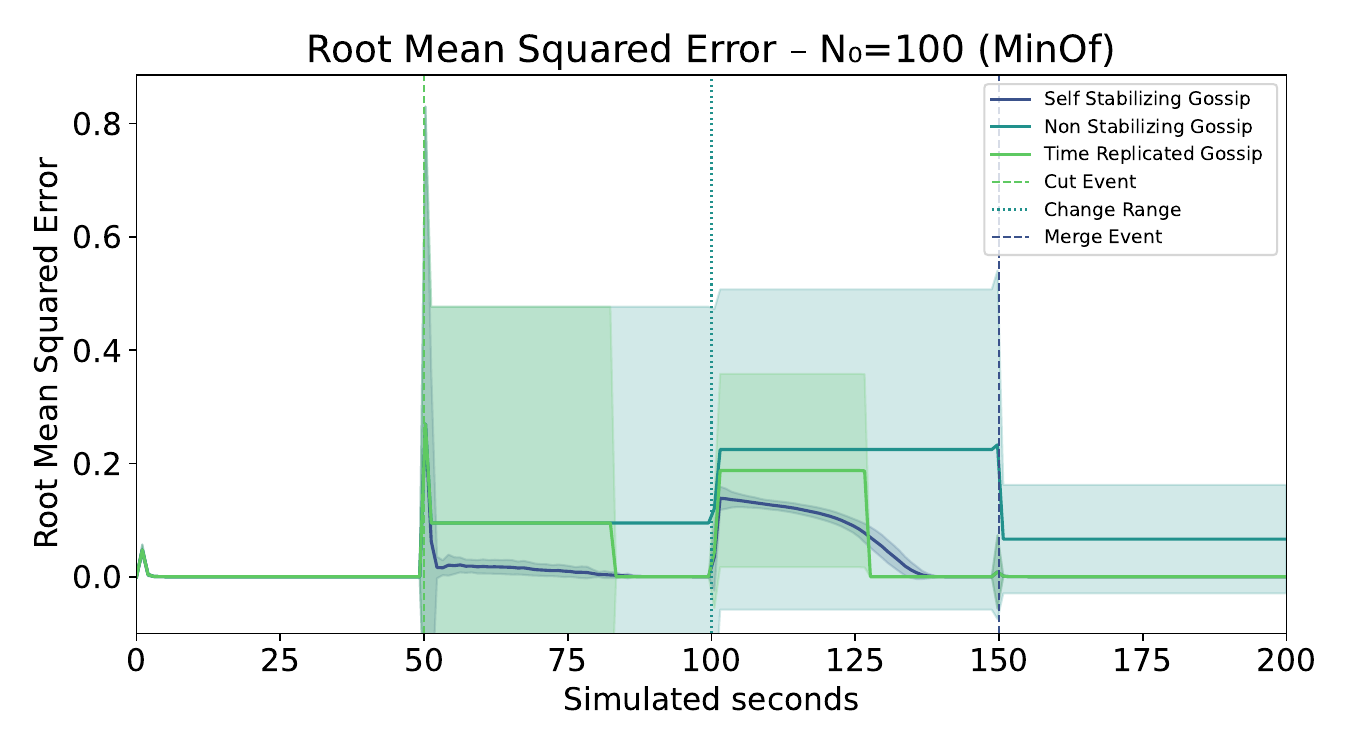
RMSE over time. Vertical lines show the disruption events (cut, change of values, merge), shaded areas show mean .
- The non-stabilizing gossip fails to converge after any of the perturbations.
- The self-stabilizing gossip starts converging as soon as a perturbation occurs, with a smooth decrease of the error, as stale candidates are progressively pruned through loop detection.
- The time-replicated gossip reaches the correct values with a delayed, step-like pattern, once the first replica that captured the new values becomes valid: a well-tuned instance may reach the final value sooner, while the proposed algorithm offers a lower error during the transient.
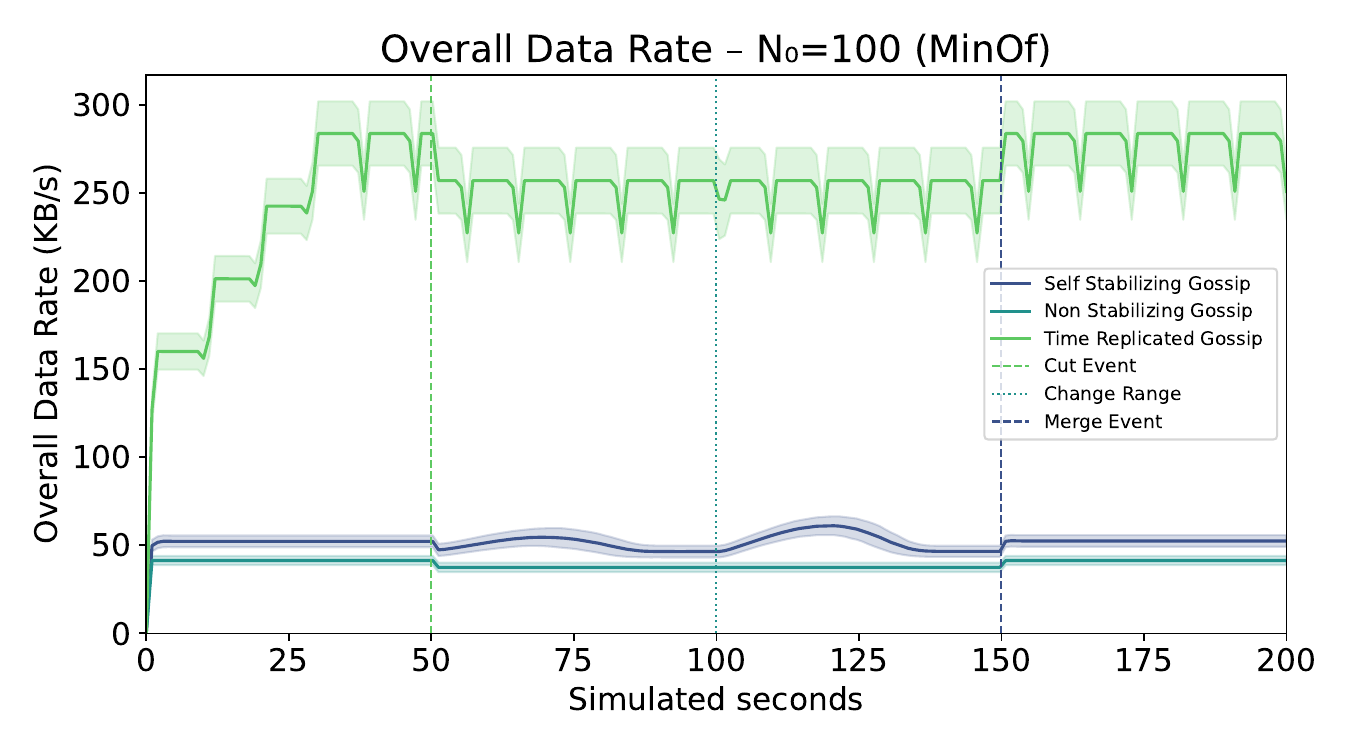
Overall data rate used by all devices over time.
The proposed algorithm requires a slightly higher data rate than the non-stabilizing baseline (due to the path data), but its communication overhead is about four times lower than time-replicated gossip, whose periodic replicas are clearly visible in the chart.